SDH & SONET
Synchronous Digital Hierarchy and Synchronous Optical Networking Infrastructure
Overview
Synchronous Digital Hierarchy (SDH) represents a globally standardized optical transport network architecture that enables the reliable transmission of time-division multiplexed (TDM) circuits, asynchronous transfer mode (ATM) circuits, and Ethernet traffic within a synchronized digital hierarchy. SDH has been formally standardized by ETSI and the International Telecommunication Union (ITU-T) through recommendations G.707 (1/2007), G.783, G.784, and G.803 (3/1993).
Synchronous Optical Networking (SONET) is functionally equivalent to SDH, developed through Telcordia and ANSI standards (T1.105). Both technologies provide identical capabilities for optical fiber transport with deterministic transmission characteristics and absolute quality-of-service guarantees through fixed bandwidth allocation.
SDH Network Specifications
- •STM1 (155 Mbps) - Basic SDH transport hierarchy level
- •STM4 (622 Mbps) - Four-level multiplexed transport
- •STM16 (2.5 Gbps) - Enterprise-grade transmission capacity
- •STM64 (10 Gbps) - High-capacity metropolitan networks
- •STM256 (40 Gbps) - Ultra-high-capacity core networks
SONET Network Specifications
- •OC1 (51.84 Mbps) - Base optical level (not universally supported)
- •OC3 (155.52 Mbps) - Equivalent to SDH STM1
- •OC12 (622.08 Mbps) - Equivalent to SDH STM4
- •OC48 (2.5 Gbps) - Equivalent to SDH STM16
- •OC192/OC768 (10/40 Gbps) - High-capacity core transmission
Technical Architecture
Synchronous Transmission Framework
SDH/SONET architecture implements a high-precision synchronous network utilizing a unified master clock. This clock source generates a complete digital hierarchy with high-order multiplexing across large network nodes and low-order multiplexing within nodes, creating virtual containers (VC) and tributary units (TU) for structured signal mapping of variable bit-rate traffic.
Virtual Container Technology
Virtual containers enable simultaneous transport of multiple independent circuit types:
- •Voice & TDM Traffic: E1/T1 signals transported via VC12/VC11 containers
- •Data & IP Networks: Ethernet and IP traffic mapped into concatenated n×VC3 or n×VC4 structures
- •ATM Networks: Asynchronous transfer mode circuits transported via VC4c containers
Each virtual container operates as an independent circuit with permanent bandwidth reservation, dedicated synchronization, and absolute quality-of-service guarantees unaffected by other circuits sharing the same optical fiber.
Network Infrastructure & Protection Mechanisms
Point-to-Point & Bus Topology
Multiplexer Section Protection (MSP 1+1)
MSP 1+1 protection utilizes dual fiber pairs (RX/TX), with one pair serving as the working path and the second providing complete redundancy. Full protection encompasses all virtual circuit containers (VCxx) with automatic recovery initiated within 50 milliseconds upon fiber failure detection.
Ring Topology
Sub-Network Connection Protection (SNCP)
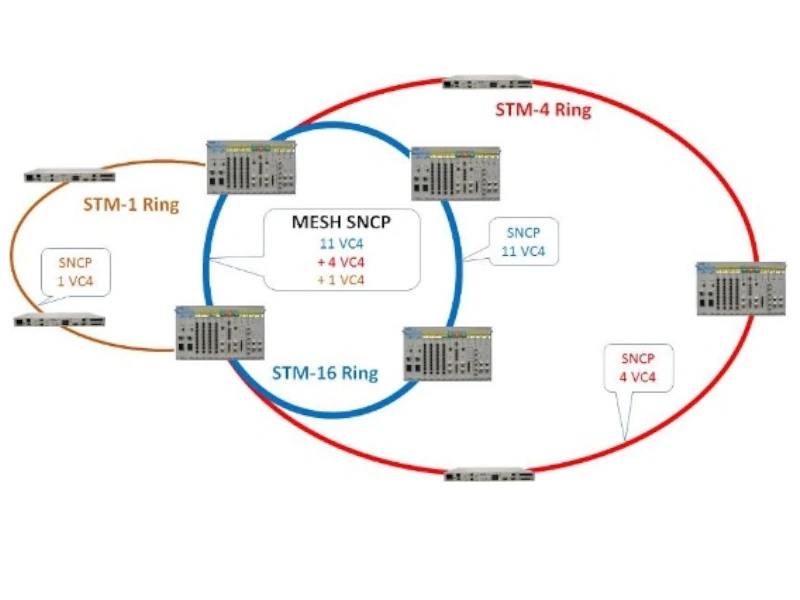
SNCP protection is implemented over a single dual-fiber optical ring, supporting up to 64 SDH/SONET nodes with bidirectional counter-rotating transmission. The working path represents the shortest bidirectional route between two nodes, while the protection path utilizes the complementary ring section. SNCP protection is independently configured per circuit and node pair, enabling selective bandwidth optimization. Recovery time for SNCP is less than 50 milliseconds with near-identical bidirectional transmission timing characteristics.
Mesh Network Topology
SNCP-MESH Protection
SNCP-MESH architecture enables multiple interconnected ring protection domains to share optical transport resources. This topology provides maximum flexibility for large-scale deployments, allowing aggregate or tributary ring protection at both core and edge network levels.
Long-Distance & Distributed Architecture
MS-SPRing (Multiplexed Section-Shared Protection Ring): Supports four-fiber ring implementations for long-distance backbone networks with shared protection signaling.
Dual Homing Protection: Sophisticated protection architecture for large central nodes distributed across multiple buildings (MOCC and BOCC), transporting all circuits across four independent optical paths with redundant system components including CPUs and power supplies.
TDM/PDH Transport
SDH/SONET systems provide seamless transport of legacy telecommunications infrastructure including:
- •E1/T1 circuits and CAS signalization
- •PRI (Primary Rate Interface) signalization
- •E3/T3 trunk circuits
- •Plesiochronous Digital Hierarchy (PDH) multiplexer outputs
- •Synchronization distribution to downstream nodes
Ethernet over SDH/SONET
Modern SDH/SONET networks support Ethernet transport through standardized ITU-T EoS (Ethernet over SDH/SONET) protocols:
- •GFP-F: Generic Framing Protocol (ITU-T G.7041) for Ethernet/HDLC frame encapsulation
- •VCAT: Virtual Concatenation for dynamic bandwidth allocation
- •LCAS: Link Capacity Adjustment Signaling for dynamic reallocation
Ethernet Service Models
E-Line Services
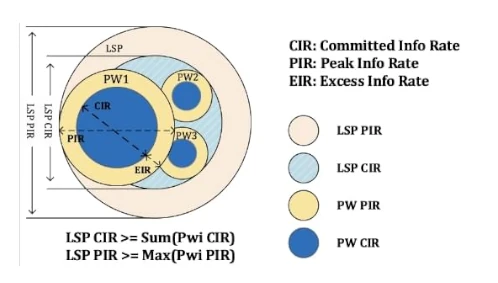
Point-to-point Ethernet circuits providing dedicated virtual connections with fixed bandwidth guarantees over SDH/SONET optical infrastructure.
E-LAN Services
Multi-point Ethernet Local Area Network services enabling LAN extension across multiple SDH/SONET nodes with broadcast and multicast capabilities.
Layer 2 Switch Capabilities
Gigabit Ethernet cards provide advanced Layer 2 switching functionality including:
- •Protocol flow control and traffic shaping
- •VLAN and Q-in-Q (double VLAN) tagging
- •RSTP/MSTP (Rapid/Multiple Spanning Tree Protocol)
- •IGMP (Internet Group Management Protocol) for multicast
- •Aggregate throughput up to 622 Mbps or 2.5 Gbps
Operations, Administration & Maintenance (OAM)
SDH/SONET OAM functions are transport directly within the optical signal overhead structure, providing in-band management without consuming user bandwidth:
- •Multiplexer section protection activation
- •System management and configuration
- •Error monitoring and reporting
- •Voice communication channels between nodes
Synchronization Distribution
Clock synchronization is critical to SDH/SONET network stability and performance. Multiple clock sources are supported at each node:
- •Primary clock or Stratum/Synchronization Supply Unit (SSU)
- •Synchronization status messaging (SSM) for clock quality validation
- •Internal system clock fallback
- •Loop-prevention mechanisms in synchronization chains
Transport Media & Extension
SDH/SONET networks support multiple physical media for transport:
- •Optical Fiber: Primary media for SDH/SONET transport (most deployments)
- •Microwave Radio Links: Directional radio systems for short-haul connections
- •Copper Transmission: STM1 over copper links (legacy deployments)
Long-Distance Extension
Long-distance networks utilize optical regenerators or wavelength division multiplexing (WDM) systems for extension:
- •Optical Regenerators: Signal regeneration at intervals for long-haul distances
- •CWDM: Coarse wavelength division multiplexing for fiber utilization
- •DWDM: Dense wavelength division multiplexing for maximum fiber capacity
Network Management & Orchestration
Professional management platforms provide integrated control and monitoring of complex SDH/SONET networks:
- •Network Topology Visualization: Real-time mapping of network structure and connections
- •Circuit Creation: End-to-end A-to-Z circuit provisioning with automatic node configuration
- •Multi-Technology Support: Mixed circuit routing across TDM/PDH, SDH/SONET, Ethernet, and MPLS domains
- •Service Monitoring: Real-time performance tracking and fault detection
SDH/SONET Network Characteristics
- ✓Circuit-oriented transport architecture
- ✓Unified synchronous clock hierarchy
- ✓Deterministic transmission with guaranteed QoS
- ✓Seamless TDM/PDH network integration
- ✓Fixed-rate Ethernet transport with LCAS flexibility
- ✓Deterministic protection with <50ms recovery
- ✓Comprehensive in-band OAM capabilities
- ✓Automated end-to-end network commissioning
Ideal Applications
Telecommunications
Voice, data, and video transport for carrier networks with guaranteed service levels
Mission-Critical Communications
Military, emergency services, and security applications requiring absolute reliability
Industrial & Infrastructure
Power grid, transportation networks, oil & gas operations with strict uptime requirements
Enterprise Networks
Large-scale multi-location networks requiring deterministic performance and redundancy